
MRD attaches great importance to maintaining the acknowledged high standard of its peer-reviewed sections. The sections (see individual descriptions) offer a selection of recent, original research on mountains, validated sustainable mountain development experiences, and reviews of the state of the art with corresponding agendas for mountain research and policy. Coverage ranges widely, from topics in the natural sciences to anthropological, economic, political, and sociocultural issues. Contributions have contemporary relevance, offer scientific insights or methodological innovations, include disciplinary, interdisciplinary, and transdisciplinary approaches, and are relevant to sustainable mountain development and policy.
Manuscripts submitted for publication in MRD must not have been published elsewhere. Papers must present arguments and evidence in a concise and readable form (maximum length according to guidelines = 25,000 characters including spaces, not counting the list of references). They are written by scholars and development specialists from throughout the world and cover all continents. Contributions by authors from developing countries are encouraged.
All manuscripts submitted to the editors for publication in one of MRD’s three peer-reviewed sections are sent to at least two independent reviewers. Reviewers of papers in all three peer-reviewed sections are requested to assess the value of the manuscript in terms of novelty, scholarship, readability, and relevance to mountains and sustainable development. In addition, reviewers of MountainDevelopment papers are asked to assess the practical value of the insights presented, while reviewers of MountainAgenda papers comment on the relevance of the research or policy agenda. The review process is strictly confidential. It is a double-blind process for MountainDevelopment and MountainResearch papers: authors’ identities are not disclosed to reviewers, and reviewers’ identities are not disclosed to authors unless explicitly requested by the reviewers. MountainAgenda articles are reviewed in a more open process by the Editors and a member of the International Editorial Board or an expert designated by them, and identities are disclosed among reviewers and authors.
Three types of knowledge for sustainable development—three peer-reviewed sections
Papers in MRD cover several types of knowledge. The following distinction between knowledge types is useful in sustainable development research and is used to distinguish between MountainDevelopment, MountainResearch, and MountainAgenda articles:
Systems knowledge describes how current systems—ie society, the economy, the environment, etc—work. In order to shape sustainable development, all actors concerned need to develop target knowledge, ie they need to be involved in defining a vision and negotiating what are the “right” things that need to be achieved. They do this on the basis of systems knowledge, which helps to enhance understanding of complex wholes. Transformation knowledge is needed to shape the transition from a given state of development to a more sustainable one, ie to decide how to do the “right” things and put the vision of sustainable development into practice, and to define what corrective action is needed.
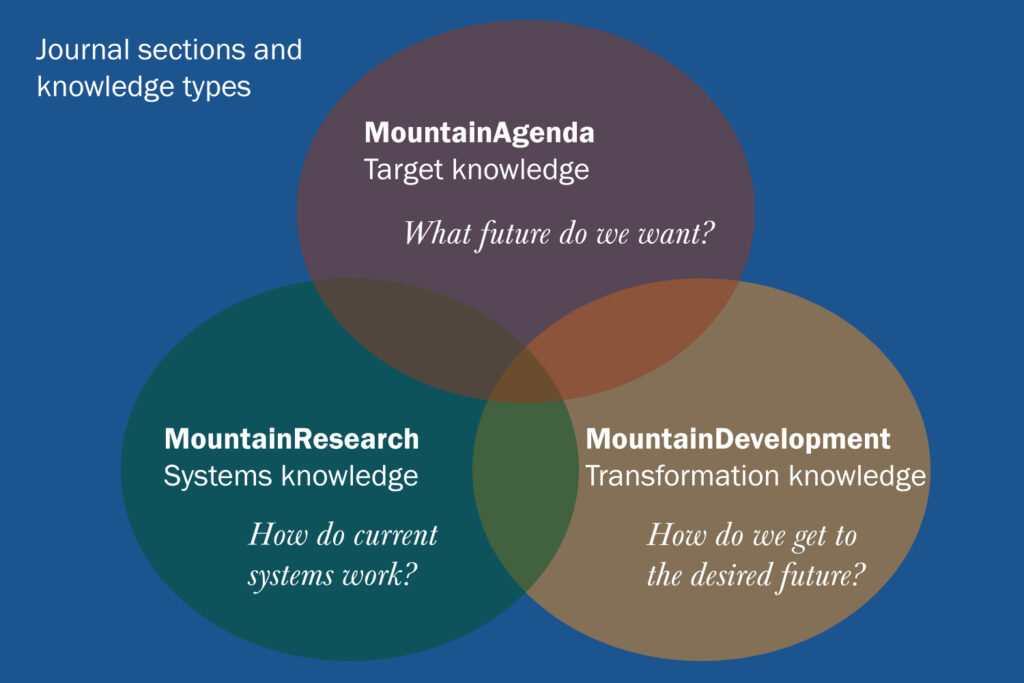 Based on td-net and NCCR North-South definitions. See also the editorials in MRD 29.1, MRD 31.1, and MRD 33.4.
MountainDevelopment
- Peer-reviewed
- Indexed
- Open submissions
- In color
The purpose of papers in MountainDevelopment is to offer knowledge about how to effectively solve problems or tap opportunities in mountain regions in order to move towards a more sustainable future. Such knowledge is also referred to as “transformation knowledge.” MountainDevelopment articles present well-structured and systematically validated knowledge gained from development interventions, local practices, and policy efforts, or insights from transdisciplinary and practice-oriented research. Authors are invited to not only discuss successes but also reflect on lessons learned from challenging experiences. Conclusions should contain “short and crisp” key messages for practitioners, policymakers, and decision-makers. MountainDevelopment articles can—but need not—address themes announced on MRD’s website.
Papers should address a multidisciplinary community of development-oriented researchers, policymakers, decision-makers, practitioners, etc. The review criteria focus on the novelty and systematic assessment of insights and their relevance for transformative change in mountains. Manuscripts are reviewed by two or more international academic and development experts.
MountainResearch
- Peer-reviewed
- Indexed
- Open submissions
The purpose of papers in MountainResearch is to present “systems knowledge,” ie knowledge describing how current systems—society, the economy, the environment, etc—work and how they might work in future. Articles in this section offer original and innovative scientific research relevant to sustainable mountain development. MountainResearch articles can—but need not—address themes announced on the MRD website.
Papers should address a scientific community interested in mountains, mountain people, sustainable mountain development, development-oriented research, and interdisciplinary interaction. Disciplinary papers are welcome provided they address an academic audience broader than that dealing with the specific field of research presented. Manuscripts are reviewed by two or more international academic experts.
MountainAgenda
- Peer-reviewed
- Indexed
- Open submissions
The purpose of papers in MountainAgenda is to present “target knowledge,” ie knowledge about what are the “right” things that need to be achieved when targeting sustainable development; stakeholders negotiate and define this on the basis of systems knowledge. Articles should therefore offer well-referenced overviews of the state of the art in mountain research, mountain development, or mountain policy and conclude with agendas for future research, development, or policy in the area reviewed. Moreover, these agendas should be guided explicitly by the values of sustainable development. MountainAgenda articles are usually written by a renowned expert in the field or by several experts in a number of different disciplines or sectors who have conducted an in-depth reflection on important issues debated at major conferences and workshops, in electronic forums, in research groups, etc. MountainAgenda articles can—but need not—address themes announced on the MRD website.
Depending on the aim of the agenda presented, papers will address a scientific, development, or policy community, or a mixed audience. MountainAgenda articles are reviewed by the Editors or a member of the International Editorial Board, as well as an additional expert designated by them. The review process is open: in shaping target knowledge, values are explicitly at stake, hence authors and reviewers should have the possibility to engage in a discussion about these values.
MountainPlatform
- For IMS members only
- Indexed
This section is reserved for institutional members of the International Mountain Society (IMS), who use it to present information about their mountain initiatives, priorities, and networks.
MountainMedia
- Invited submissions
- Indexed
Books on mountain-relevant topics are reviewed by experts on request from the MountainMedia Editor (Dr. Carolina Adler, Mountain Research Initiative, Centre for Development and Environment, University of Bern, Switzerland).
MountainViews
- Open submissions
- Indexed
This section occasionally publishes Letters to the Editor containing various forms of responses from readers to material published in MRD, etc. It offers a platform for exchange of comments and for innovative formats.